 by CMID
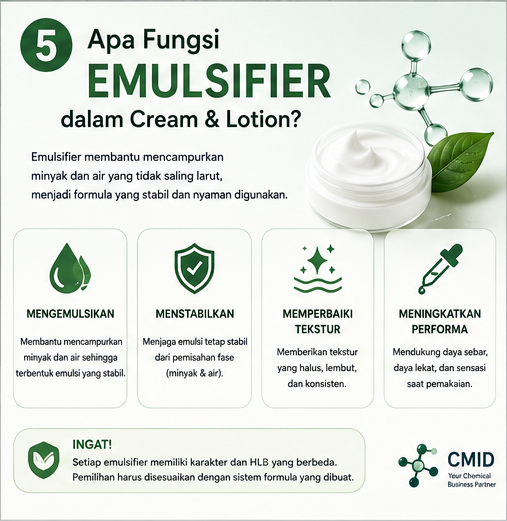
Creams and lotions generally contain oil and water phases. Because these do not naturally mix, a formulation needs an emulsifier system to help form and maintain the emulsion.
What does an emulsifier do?
In general, an emulsifier helps bring the oil and water phases together and maintain dispersion between them. The emulsifier system can also influence product character and texture.
Selection is not independent of the rest of the formula. Consider both phases’ compositions, other ingredients, sensory objectives and the overall formula evaluation.
What to remember
Do not select an emulsifier solely because its name is popular. Start with the system and product characteristics you want to develop.
This article gives no HLB calculations, dosages, temperatures, mixing conditions or universal emulsifier recommendations. The visuals are educational illustrations, not formulation authority.
Translated text from article illustrations
The text below corresponds to the original artwork. It does not confer additional formulation, use or safety approval. Read it with the scope limits in the article.
Text in illustration 1
What does an emulsifier do in creams and lotions? An emulsifier helps combine immiscible oil and water into a stable formula comfortable to use.
Emulsifying: helps combine oil and water into a stable emulsion. Stabilising: keeps the emulsion stable against oil/water phase separation. Improving texture: gives a smooth, soft and consistent texture. Enhancing performance: supports spreadability, adhesion and the feel during use.
Remember: emulsifiers differ in characteristics and HLB. Selection must match the formulation system being developed.