 by CMID
Technical correction to the original illustration
Correction to the original illustration: the label “D&C Green 7” is unverified and must not be used as an example of an approved dye. BPOM lists CI 74260 as Pigment Green 7, with application-area restrictions; this does not establish that the two names are equivalent. Solubility, heat/light resistance, lake substrate and colour strength must be checked for the actual identity and medium/application. The image is retained as a historical illustration, not a list of permissions or a safety guarantee. Use the applicable identity, specifications and conditions of use.
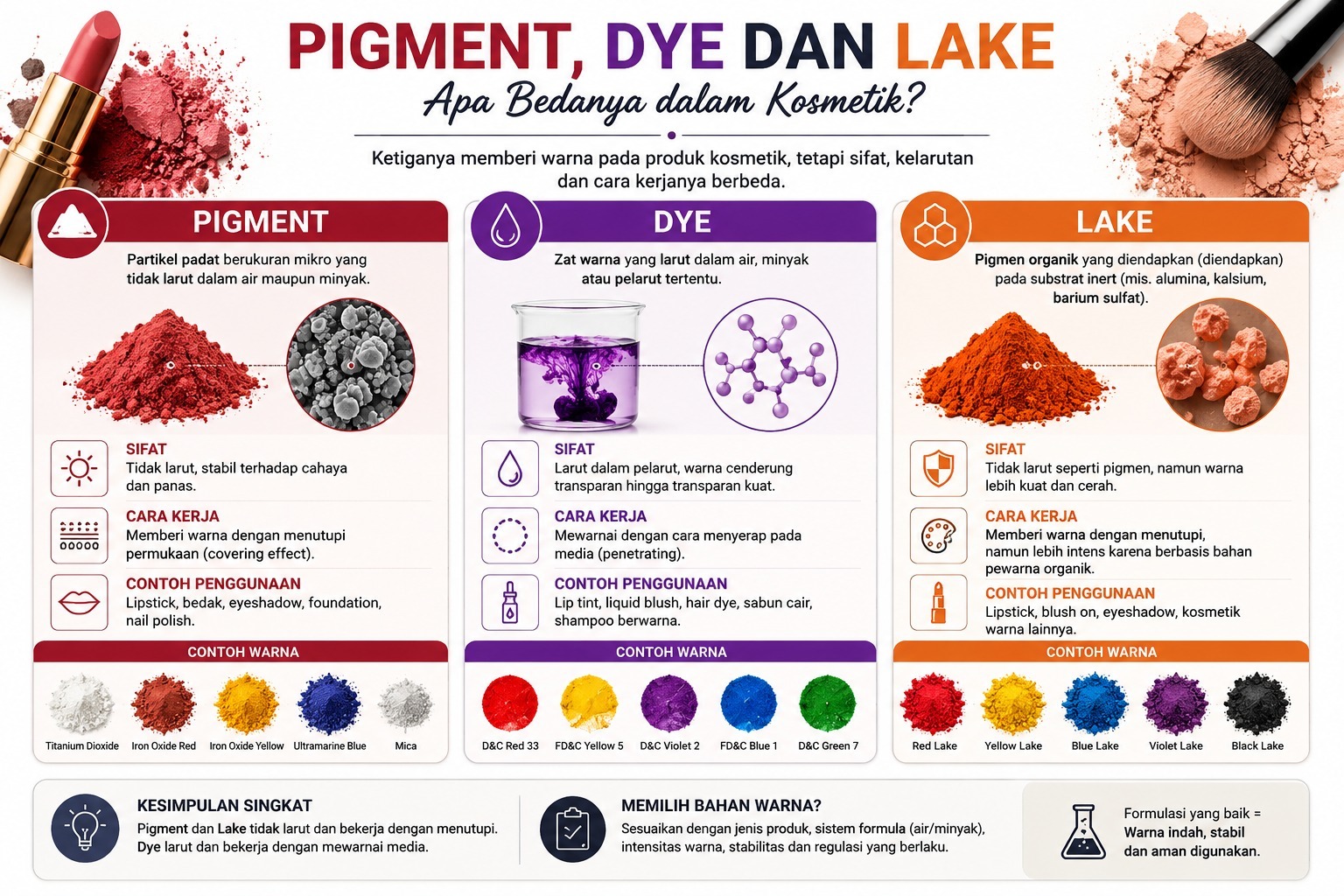
Not all colourants work in the same way. Pigment, dye and lake are common terms in colour discussions, but their use characteristics differ.
Pigment
A pigment is a particulate colourant generally used as an insoluble material in a particular formulation medium. Colour is obtained by dispersing particles in the system.
Dye
A dye is a colourant that works by dissolving in a suitable medium.
Lake
A lake is a form of colourant made by binding or precipitating a dye onto a particular substrate, giving it different use characteristics from a soluble dye.
Why does the distinction matter?
Colourant selection should consider product type, formulation system, colour characteristics, stability and applicable use requirements.
The question is therefore not “Which colour is best?” but “Which type of colourant suits the product system being developed?”
This article is conceptual. It states no universal cosmetic suitability, regulatory approval list, suitability of every visual example for every application or dosage recommendation.
Translated text from article illustrations
The text below corresponds to the original artwork. It does not confer additional formulation, use or safety approval. Read it with the scope limits in the article.
Text in illustration 1
Pigments, dyes and lakes: what is the difference in cosmetics? All three colour cosmetic products, but their properties, solubility and mechanisms differ.
Pigment: microscopic solid particles insoluble in both water and oil. Properties: insoluble, stable to light and heat. Mechanism: colours by covering a surface. Use examples: lipstick, face powder, eye shadow, foundation and nail polish. Colour examples: Titanium Dioxide; Iron Oxide Red; Iron Oxide Yellow; Ultramarine Blue; Mica.
Dye: a colourant soluble in water, oil or a particular solvent. Properties: dissolves in a solvent; colour tends to be transparent through to strongly transparent. Mechanism: colours by penetrating the medium. Use examples: lip tint, liquid blush, hair dye, liquid soap and coloured shampoo. Colour examples: D&C Red 33; FD&C Yellow 5; D&C Violet 2; FD&C Blue 1; D&C Green 7.
Lake: an organic pigment precipitated (word repeated in the original) onto an inert substrate (for example alumina, calcium, barium sulfate). Properties: insoluble like a pigment, but with stronger, brighter colour. Mechanism: colours by covering, with greater intensity because it is based on an organic colourant. Use examples: lipstick, blush, eye shadow and other colour cosmetics. Colour examples: Red Lake; Yellow Lake; Blue Lake; Violet Lake; Black Lake.
Brief conclusion: pigments and lakes are insoluble and work by covering. Dyes dissolve and colour the medium. Choosing a colourant? Match product type, formula system (water/oil), colour intensity, stability and applicable regulations. A good formulation = attractive colour, stability and safety in use.