 by CMID
Technical correction to the original illustration
Correction to the illustrated comparison: O/W and W/O identify the dispersed and continuous phases; they do not determine emollient content, greasiness, absorption, occlusivity or water resistance. Croda provides a light, non-greasy W/O example. Therefore, “lighter O/W” or “richer W/O” can only describe tendencies in particular formulations, not universal selection rules. Evaluate the complete composition, emulsifier system, processing and test results. The original image is retained; this note supersedes its unconditional generalizations.
A cream or lotion looks like a unified product, but many formulations actually combine an oil phase and a water phase.
Because oil and water do not naturally mix, an emulsion formulation needs a system that helps keep the two phases dispersed.
One basic concept is the difference between O/W and W/O emulsions.
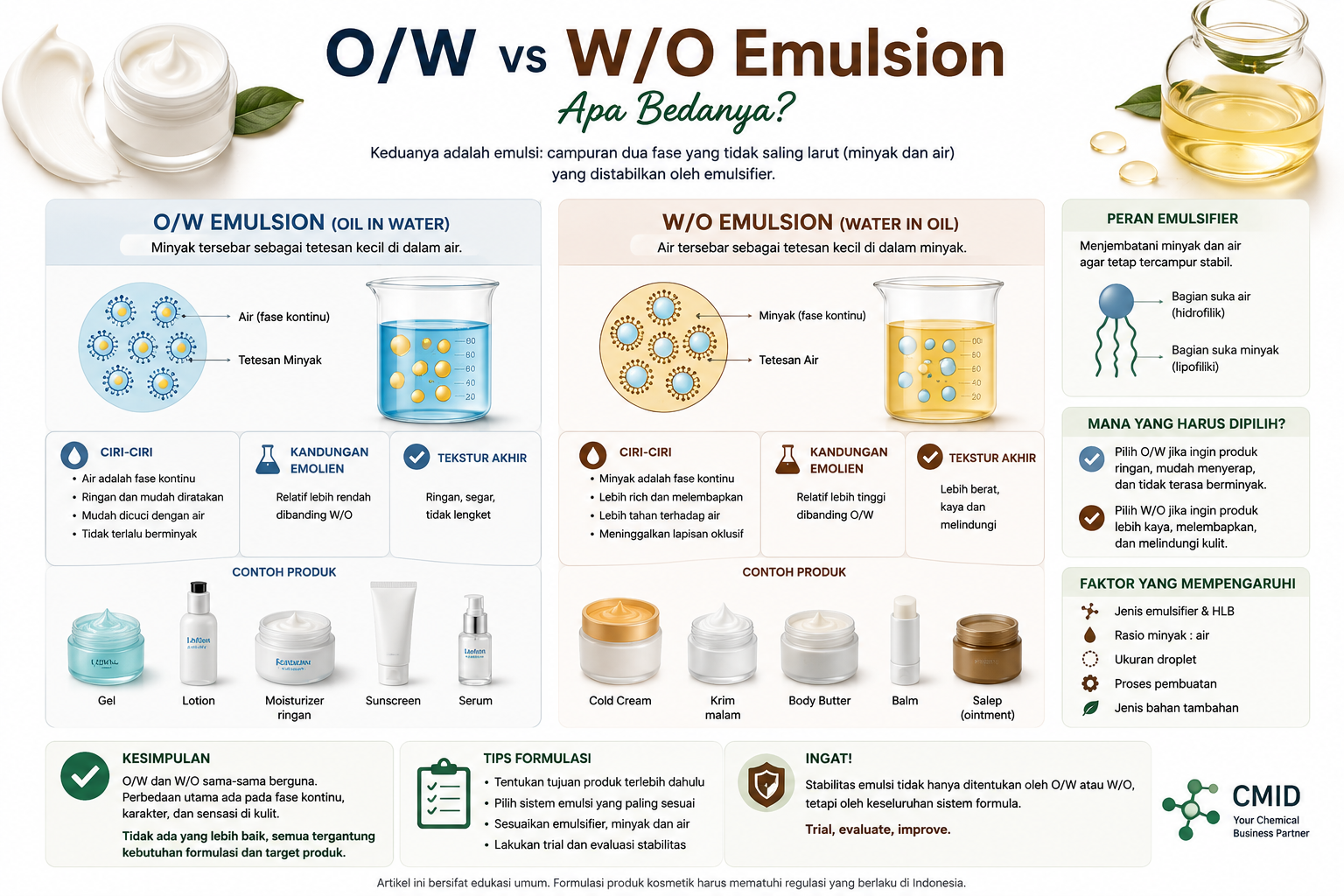
What is O/W?
O/W meansOil in Water.
In this system, the oil phase is dispersed within the water phase, which is the continuous phase.
In general, O/W systems are often used when a formulation aims for lighter, more readily spreadable characteristics.
What is W/O?
W/O meansWater in Oil.
In this system, the water phase is dispersed within the oil phase, which is the continuous phase.
W/O systems may be used when a formulation requires richer or more occlusive characteristics.
What does an emulsifier do?
An emulsifier helps form and maintain dispersion between the oil and water phases.
However, an emulsifier cannot be selected solely on the labels O/W or W/O. The formulator must still consider the complete formulation system.
Which is better?
There is no universal answer. O/W is not automatically better than W/O, nor is W/O automatically better than O/W.
The choice depends on:
- product objectives
- use characteristics
- oil- and water-phase composition
- the emulsifier system
- other formula ingredients
- trial results and stability evaluation
Conclusion
When developing a cream or lotion, do not ask only: “Which emulsifier should I use?”
Start by asking: “What product characteristics do I want to create?”
From there, the emulsion system and ingredients can be evaluated more systematically.
The visuals in this article are educational illustrations, not formulation authority. This article provides no formula percentages, HLB calculations, emulsifier dosages, processing temperatures, mixing speeds, homogenisation conditions, universal product recommendations, regulatory approval claims or guarantees of stability.
Translated text from article illustrations
The text below corresponds to the original artwork. It does not confer additional formulation, use or safety approval. Read it with the scope limits in the article.
Text in illustration 1
O/W versus W/O emulsions: what is the difference? Both are emulsions: mixtures of two immiscible phases (oil and water) stabilised by an emulsifier.
O/W (oil-in-water): oil is dispersed as small droplets in water. Water (continuous phase); oil droplets. Characteristics: water is the continuous phase; light and easy to spread; readily washed with water; not very oily. Emollient content is relatively lower than in W/O. Final texture: light, fresh and non-sticky. Product examples: gel; lotion; light moisturiser; sunscreen; serum.
W/O (water-in-oil): water is dispersed as small droplets in oil. Oil (continuous phase); water droplets. Characteristics: oil is the continuous phase; richer and more moisturising; more water-resistant; leaves an occlusive layer. Emollient content is relatively higher than in O/W. Final texture: heavier, rich and protective. Product examples: cold cream; night cream; body butter; balm; ointment.
Emulsifier role: bridges oil and water so they remain stably mixed. Water-loving part (hydrophilic); oil-loving part (lipophilic). Which should be selected? Select O/W for a light, readily absorbed product without an oily feel. Select W/O for a richer, moisturising, skin-protecting product.
Influencing factors: emulsifier type and HLB; oil-to-water ratio; droplet size; manufacturing process; type of additional ingredients.
Conclusion: O/W and W/O are both useful. The main differences concern the continuous phase, characteristics and skin feel. Neither is better universally; selection depends on formulation requirements and product objectives. Formulation tips: define the product objective first; select the most appropriate emulsion system; adjust emulsifier, oil and water; conduct trials and stability evaluation. Remember: emulsion stability depends on the whole formula, not only O/W or W/O. Trial, evaluate, improve. This is general education. Cosmetic formulations must comply with applicable Indonesian regulations.