 by CMID
Technical correction to the original illustration
Clarification of the original illustration: melting, dispersion, mixing and moulding are an educational schematic, not a complete or validated manufacturing procedure. A manufacturer example uses specific ingredients, phases and processing; its sequence cannot automatically be transferred to another formula. “Ready to use” and “safe and compliant” in the image are not test results or authorization for a particular product. Product release requires evaluation of the formulation, processing, safety, stability and applicable requirements. The historical image and text are retained; this note limits their interpretation.
Völpker Lipstick Base Formulation V-cos-001·FDA Microbiological Safety and Cosmetics
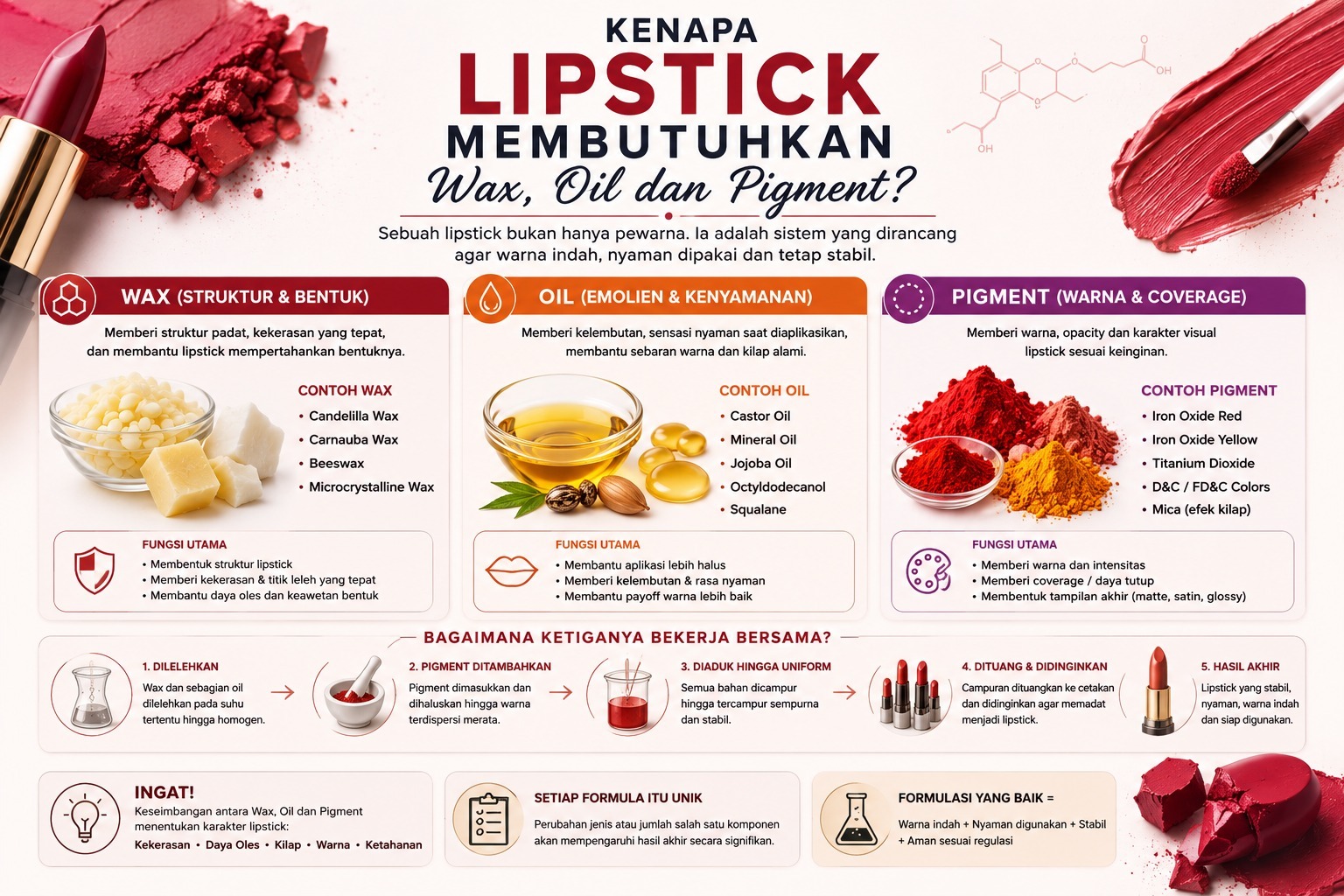
Lipstick is more than a colourant shaped into a stick. Its final characteristics arise from balancing several ingredient groups with different functions.
Wax — structure
Wax helps form structure, hardness and the lipstick’s ability to retain its shape.
Oil / emollient — application and comfort
The oil or emollient phase helps carry and distribute formula components and influences application characteristics and product feel.
Pigment — colour
Pigment provides colour and visual characteristics. Its dispersion in the system also affects final appearance.
Why must they be balanced?
Changing one part of the system can affect hardness, application, appearance, colour and stability.
Making lipstick therefore involves more than mixing wax, oil and pigment. Understand each ingredient group’s function and evaluate results through trials.
This article provides no percentages, complete recipe, melting temperatures, mixing sequence or guarantees of safety and regulatory compliance.
Translated text from article illustrations
The text below corresponds to the original artwork. It does not confer additional formulation, use or safety approval. Read it with the scope limits in the article.
Text in illustration 1
Why does lipstick need wax, oil and pigment? A lipstick is more than a colourant. It is a system designed for attractive colour, comfortable use and stability.
Wax (structure and shape): provides solid structure and appropriate hardness, and helps lipstick retain its shape. Examples: Candelilla Wax; Carnauba Wax; Beeswax; Microcrystalline Wax. Main functions: forms lipstick structure; provides appropriate hardness and melting point; supports application and lasting shape.
Oil (emollience and comfort): provides softness and a comfortable application feel, helping colour distribution and natural shine. Examples: Castor Oil; Mineral Oil; Jojoba Oil; Octyldodecanol; Squalane. Main functions: supports smoother application; provides softness and comfort; supports better colour payoff.
Pigment (colour and coverage): provides the desired colour, opacity and lipstick appearance. Examples: Iron Oxide Red; Iron Oxide Yellow; Titanium Dioxide; D&C / FD&C Colors; Mica (shine effect). Main functions: provides colour and intensity; provides coverage; shapes the final finish (matte, satin or glossy).
How do the three work together? 1. Melt: wax and some oil are melted at a particular temperature until uniform. 2. Add pigment: pigment is added and ground until colour is evenly dispersed. 3. Stir until uniform: all ingredients are mixed until fully blended and stable. 4. Pour and cool: the mixture is poured into moulds and cooled to solidify into lipstick. 5. Final result: a stable, comfortable lipstick with attractive colour, ready for use.
Remember: the balance of wax, oil and pigment determines lipstick hardness, application, shine, colour and durability. Every formula is unique: changing the type or amount of a component significantly affects the final result. A good formulation = attractive colour + comfortable use + stability + safety in accordance with regulations.