 by CMID

Why understand ingredient functions?
Personal care formulations may use ingredients with different functions. A functional-group name helps frame initial questions, but does not in itself prove that an ingredient suits a particular product, process or customer requirement.
A safer approach separates general function, actual material identity and available evidence. Manufacturer or supplier information, stated grade, specifications and relevant documentation must still be checked before evaluating an ingredient.
Functional groups as an initial map
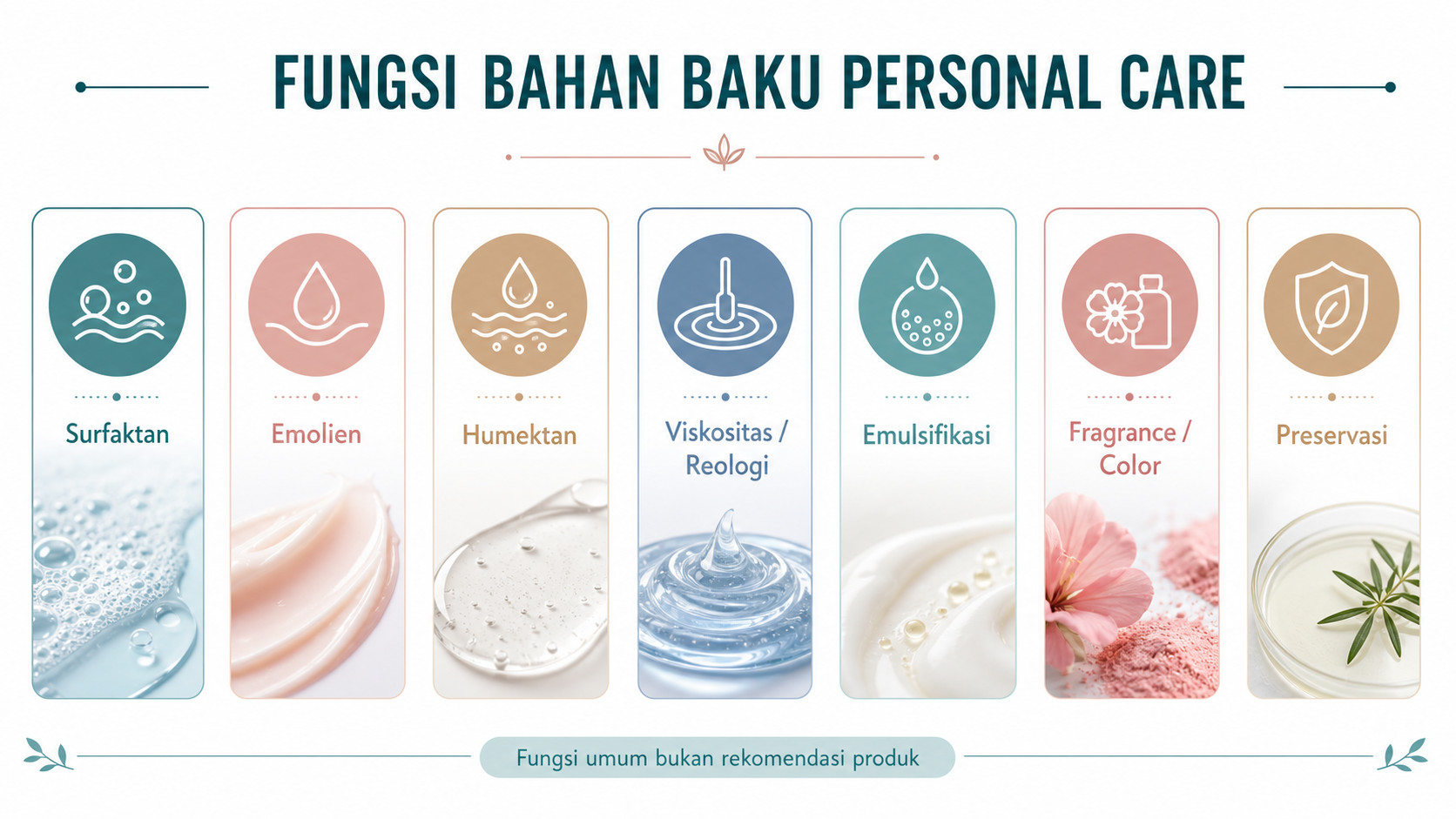
The following groups provide a general educational framework. An ingredient’s functional information can vary with its identity, system and technical source. This framework is not a formula and establishes no relationship with particular CMID products.
Surfactant-related functions
This term is used to discuss ingredients that interact at interfaces or support functions such as wetting and cleaning in particular systems. Their actual type, characteristics and role must follow the correct material information.
Emollient-related functions
This group helps interpret ingredients discussed in the context of imparting or maintaining a soft surface feel. Actual results cannot be established from the group name alone.
Humectant-related functions
Humectant refers to functions related to retaining moisture in a particular context. Material identity, the system and evaluation conditions still determine how that information should be interpreted.
Viscosity and rheology functions
This group concerns a system’s flow behaviour, structure or consistency. “Thicker” does not automatically mean “better”; compare results using appropriate methods and conditions.
Emulsification-related functions
This term helps explain ingredients associated with forming or maintaining systems involving different phases. General information establishes neither compatibility nor stability in a particular formulation.
Fragrance and colour functions
Fragrance and colour may be discussed as part of sensory characteristics or appearance. Identity, use restrictions and applicable requirements must not be inferred solely from an ingredient’s name or colour.
Preservation-related functions
This group concerns protecting products from microbiological changes in particular contexts. A functional name proves neither effectiveness, dosage, authorisation nor suitability of an ingredient.
From general function to ingredient evaluation

Use functional groups to frame questions, rather than select products automatically. Ensure materials being compared have clear identities and sufficient information for the evaluation objective.
- Define the function you want to understand.
- Check each candidate’s identity and information sources.
- Record verified information and open questions separately.
- Evaluate candidates under controlled conditions.
- Compare results only on comparable bases.
This article provides no formula, percentages, dosages, process sequence, target pH, compatibility claims or recommendations for particular products.
General references
The general functional framework refers to ingredient-function information inEuropean Commission CosIng. CosIng is informational; the presence of a name or function does not mean an ingredient is approved or suitable for a particular cosmetic use.
Translated text from article illustrations
The text below corresponds to the original artwork. It does not confer additional formulation, use or safety approval. Read it with the scope limits in the article.
Text in illustration 1
Personal care raw material functions. Surfactants; Emollients; Humectants; Viscosity/Rheology; Emulsification; Fragrance/Colour; Preservation. General functions, not product recommendations.