 by CMID
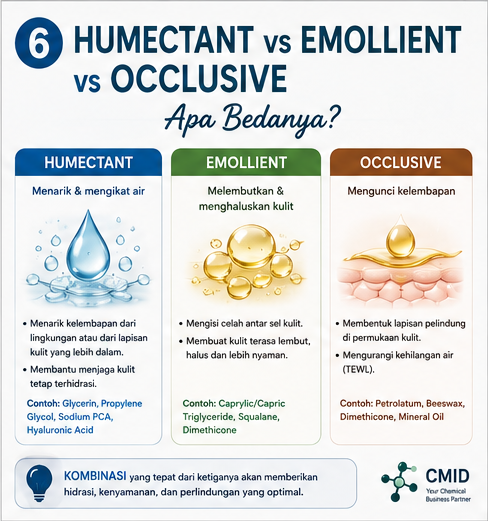
Humectants, emollients and occlusives are often discussed in personal care formulations. They describe different functions, and one formula may combine more than one.
Humectant
A humectant helps attract or retain water in the context of formulation and use characteristics. Actual results still depend on the ingredient and system.
Emollient
An emollient helps impart a soft, smooth character to the product-use experience.
Occlusive
An occlusive helps form a layer that reduces water loss in a particular use context.
You do not have to choose just one
A formulation can combine these functions according to product objectives and use experience. This is not about deciding which is “best”.
This article provides general functional education and establishes no medical benefits, particular ingredient suitability or skin-care claims.
Translated text from article illustrations
The text below corresponds to the original artwork. It does not confer additional formulation, use or safety approval. Read it with the scope limits in the article.
Text in illustration 1
Humectant versus emollient versus occlusive: what is the difference?
Humectant: attracts and binds water. Attracts moisture from the environment or deeper skin layers. Helps keep skin hydrated. Examples: Glycerin, Propylene Glycol, Sodium PCA, Hyaluronic Acid.
Emollient: softens and smooths skin. Fills gaps between skin cells. Makes skin feel soft, smooth and more comfortable. Examples: Caprylic/Capric Triglyceride, Squalane, Dimethicone.
Occlusive: locks in moisture. Forms a protective layer on the skin surface. Reduces water loss (TEWL). Examples: Petrolatum, Beeswax, Dimethicone, Mineral Oil. An appropriate combination of the three will provide optimal hydration, comfort and protection.