 by CMID

Understanding raw material functions in home care
Home care products may use several raw-material groups with different functions. Understanding functions helps customers read product information, set trial objectives and determine what should be evaluated.
The function groups below are a general educational framework. They are not a production formula and do not state that a CMID product has a particular function or suits a particular application. Product relationships must follow separately approved identities, documents and relationships.
Commonly discussed function groups
Surfactants
Surfactants are used to influence interactions between water, surfaces and other materials. Depending on type and formulation system, discussed functions can include wetting, cleaning, foam formation or control, and dispersion. Actual results must be evaluated in the formula and trial conditions used.
Builders
Builders are materials that can support a cleaning system. Their role may relate to water conditions or other factors affecting cleaning. A builder’s function and necessity cannot be determined from the category name alone.
Chelating or sequestering functions
Materials with chelating or sequestering functions interact with certain metal ions that can affect a system. Selection and use requirements need appropriate technical information and evaluation.
pH-related functions
This group includes materials used to adjust or help maintain a system’s pH. There is no universal target pH; it must be set according to product objectives, materials used and relevant evaluation.
Viscosity- or rheology-related functions
Materials in this group influence a product’s flow behaviour or consistency. Observe viscosity under actual trial conditions, as the whole system and evaluation conditions can affect results.
Solvent
Solvents can help dissolve, carry or distribute certain materials within a system. Their use must follow product information, application restrictions and the evaluation defined for that material.
Fragrance and colour
Fragrance provides scent characteristics, while colour provides a coloured appearance. Neither determines cleaning performance by itself, and both still need assessment within the product as a whole.
Preservative-related functions
Materials with preservative-related functions are used in the context of controlling quality deterioration associated with microorganisms. Selection requires technical assessment and compliance with applicable requirements; this article recommends no material or dosage.
Using a functional framework to start a trial
- Define the application and evaluation objective.
- Identify the ingredient functions to understand without immediately selecting a product.
- Study product identity and available documents.
- Record materials, conditions and trial results consistently.
- Compare results with the evaluation objective and define the next questions.
The published trial-evaluation guide can support recording and result review. Further material on surfactant types and viscosity will be displayed when available as public CMID content.
Relationship to CMID products
The CMID Product Master is the reference for product identity and approved relationships. Do not assign a product to a functional group based only on its name, shop category or assumed use. Use product pages and available documents, then contact CMID if further discussion is needed.
Translated text from article illustrations
The text below corresponds to the original artwork. It does not confer additional formulation, use or safety approval. Read it with the scope limits in the article.
Text in illustration 1
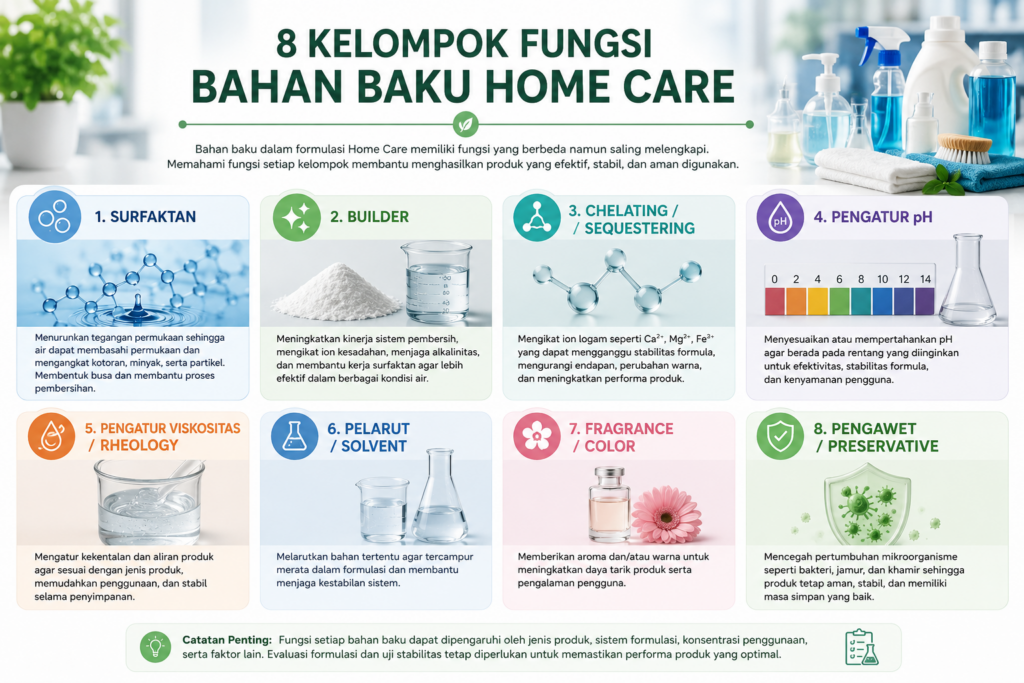
8 functional groups of home care raw materials. Home care formulation ingredients have different but complementary functions. Understanding each group helps produce effective, stable products safe to use.
1. Surfactant: lowers surface tension so water can wet surfaces and remove dirt, oil and particles. Forms foam and supports cleaning.
2. Builder: improves cleaning-system performance, binds hardness ions, maintains alkalinity and helps surfactants work more effectively in different water conditions.
3. Chelating/sequestering: binds metal ions such as Ca²⁺, Mg²⁺ and Fe³⁺ that can interfere with formula stability, reduces deposits and colour changes, and improves product performance.
4. pH adjuster: adjusts or maintains pH within a desired range for effectiveness, formula stability and user comfort. Diagram scale: 0 2 4 6 8 10 12 14.
5. Viscosity/rheology modifier: controls product consistency and flow to suit the product type, make use easier and maintain storage stability.
6. Solvent: dissolves certain ingredients for uniform distribution in the formula and helps maintain system stability.
7. Fragrance/colour: provides scent and/or colour to improve product appeal and user experience.
8. Preservative: prevents the growth of microorganisms such as bacteria, moulds and yeasts, keeping the product safe and stable with a good shelf life.
Important note: ingredient functions can be affected by product type, formulation system, use concentration and other factors. Formulation evaluation and stability testing are still needed to ensure optimal product performance.