 by CMID
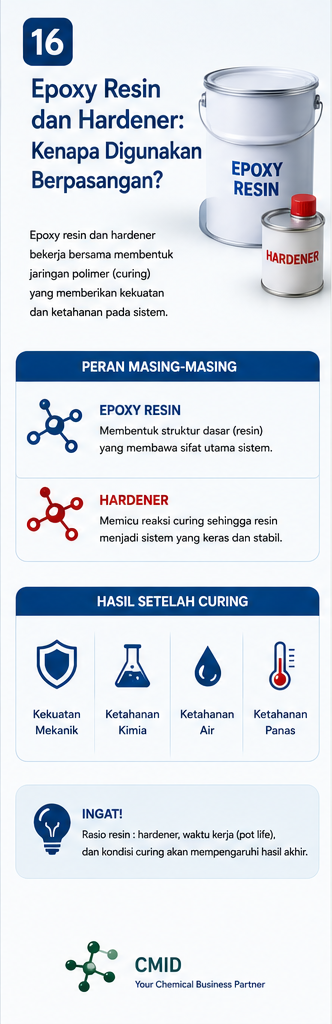
Many epoxy systems use resin together with an appropriate curing component or hardener. Their relationship is part of a designed system.
Conceptual roles
The resin contributes to the base polymer system. The hardener participates in curing according to the chemistry and design of the actual product.
Why follow the system design?
Compatibility, ratios, working conditions and curing results depend on the actual materials. Do not assume one hardener suits all epoxies merely because it has a similar general function.
Key takeaway:identify the resin and hardener designed to work together and check their technical documentation.
This article provides no mixing ratios, temperatures, curing times or claims of interchangeability.
Translated text from article illustrations
The text below corresponds to the original artwork. It does not confer additional formulation, use or safety approval. Read it with the scope limits in the article.
Text in illustration 1
Epoxy resin and hardener: why are they used together? They work together to form a polymer network (curing), giving the system strength and durability.
Respective roles. Epoxy resin: forms the base structure carrying the system's main properties. Hardener: triggers curing so the resin becomes a hard, stable system. Results after curing: mechanical strength; chemical resistance; water resistance; heat resistance.
Remember: resin-to-hardener ratio, working time (pot life) and curing conditions affect the final result.